For educators
A live legislature, in your syllabus
Your students already live in their feeds. BillTracking puts the official legislative record there too: every step of real bills moving through Congress and the EU institutions, posted as it happens, source-cited, and free. No subscription, no license fee, no paywall — nothing between your students and the record.
Why a feed, in a course
The textbook explains the process. The feed shows it running.
Every diagram of "how a bill becomes a law" is static. The feeds are that same diagram executing in real time: cloture motions failing, trilogue mandates landing, vetoes surviving or falling — during your semester, on bills your students have opinions about. This week's posts are next week's discussion material, and every post cites the official record, so it can be assigned, quoted and checked.
The record was never the problem
Congress.gov and the EU's registers have been free and public for decades — and students rarely open them unassigned. The gap was never access; it's salience. A database is where information waits; a feed is where information arrives. Students can find the legislative record, but often prefer the record to find them instead. Readership isn't always decided by where information resides — it's decided by how information flows, and feeds are how information flows today. The official record belongs in the flow, not only in the archive.
Getting started — three steps, no forms
- Follow the feed that fits your course — or both: @USBillTracker · @EUBillTracker.
- Put it in front of students — link a feed from the syllabus or LMS, or drop a ready-made follow slide into your week-one deck (all copy-paste material is in the classroom resources below).
- Optional: run the verification exercise — a ready one-page assignment where students audit the feed against the official record.
What we're asking: nothing beyond a follow, and only if it fits your course. There's no mailing list, no partnership program, no upsell. The project grows when educators who find it useful mention it to students and colleagues — that's the entire model.
Why X, of all places? Honest answer on the About page.
Course fit
Where instructors tell us it fits
Legislative process & Congress
The obvious home: a live feed of committee reports, cloture votes, conference reports and veto fights, matched to the week you teach each stage.
@USBillTracker
Intro American government
"How a bill becomes a law" with this week's real bills — including the huge intro sections where the textbook diagram usually has to carry the whole load.
@USBillTracker
EU institutions & decision-making
The ordinary legislative procedure as a live object: mandates, trilogues, readings and Official Journal publications, file by file.
@EUBillTracker
Comparative politics & legislatures
The same policy area moving through two systems at once — presidential veto against co-decision, filibuster against trilogue. One format makes them comparable.
Both feeds
Public policy & the policy process
Agenda-setting to enactment on live cases: students pick a bill in week one and follow its fate all semester.
Both feeds
Constitutional law & Leg-Reg
Presentment, the ten-day clock, pocket vetoes, override thresholds and statutory enactment — the doctrinal machinery, observed in the wild.
@USBillTracker
Political journalism
A wire of record for legislative beats: what actually happened, when, per the official record — the baseline every story should be checked against.
Both feeds
EU studies & European governance
Regulation vs directive, consent vs consultation, conciliation — the procedure's full vocabulary, used correctly, with real files attached.
@EUBillTracker
A ready-made assignment
The verification exercise
The feeds are built to be checked — which makes them a genuine methods exercise, not busywork:
- Pick a post. Each student takes one update from either feed — a committee report, a cloture vote, a trilogue deal.
- Pull the record. Find the underlying entry on Congress.gov or in the OEIL procedure file the post cites.
- Audit every claim. Dates, vote counts, stage labels, "what's next" — does the post say exactly what the record supports, no more?
- Report what you find. Discrepancies go to accuracy@billtracking.org. Confirmed reports are fixed visibly and listed in the public corrections log — with the student credited by name, if they opt in.
A credited correction is a linkable artifact. A student who catches a real error in a public record gets a permanent, citable entry in the corrections log — something concrete for a CV or graduate application. We'd genuinely rather be corrected by your students than stay quietly wrong. Group audits are welcome too — findings can be credited to a course as a whole.
Resources for your classroom
Everything here is copy-paste ready
Slides for your week-one deck, a distributable assignment, and syllabus text — built so that using the feeds in a course costs you minutes, not prep time.
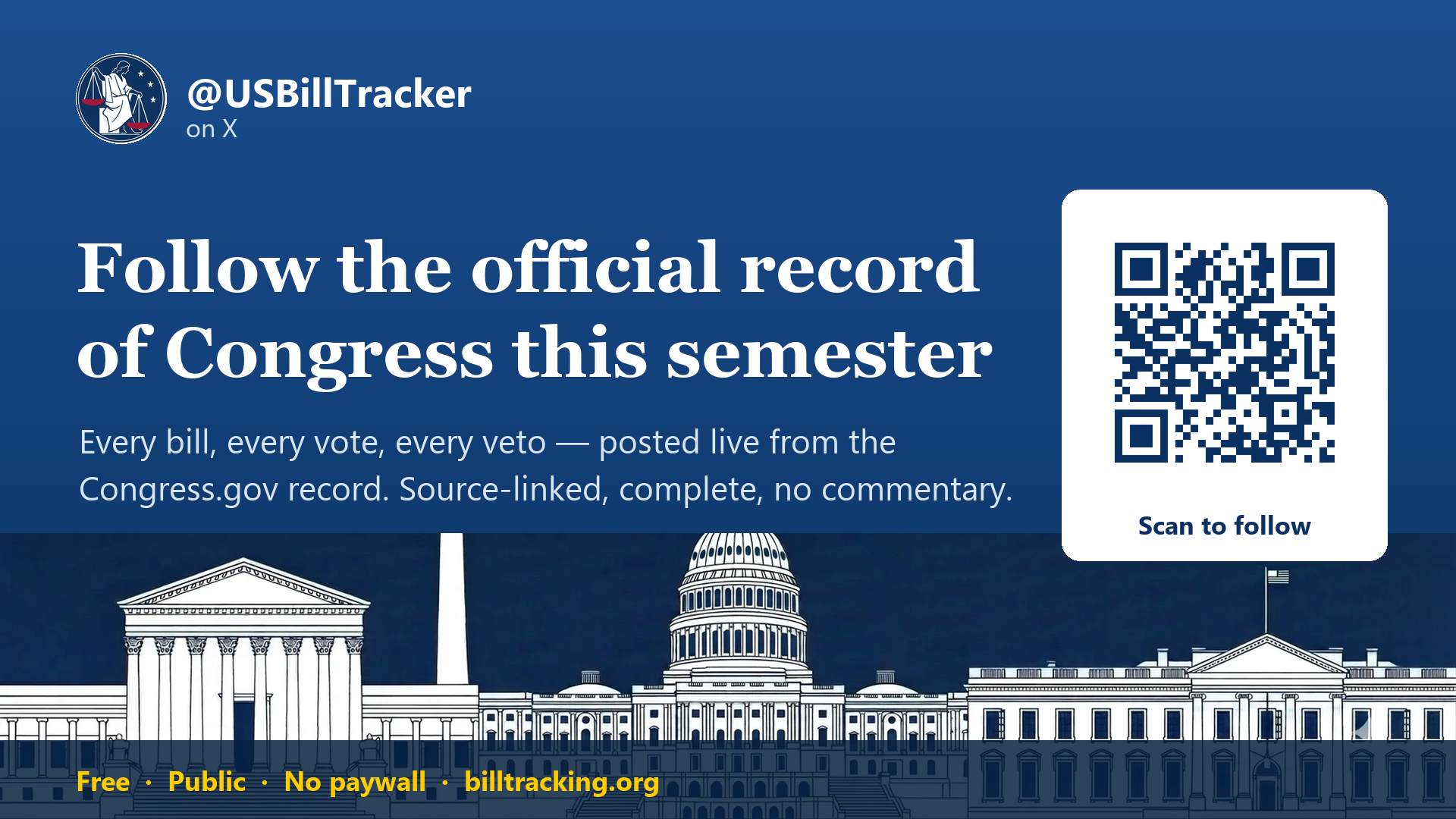
- US follow slide 1920×1080 PNG — drop into any week-one deck (@USBillTracker + QR)
- EU follow slide 1920×1080 PNG (@EUBillTracker + QR)
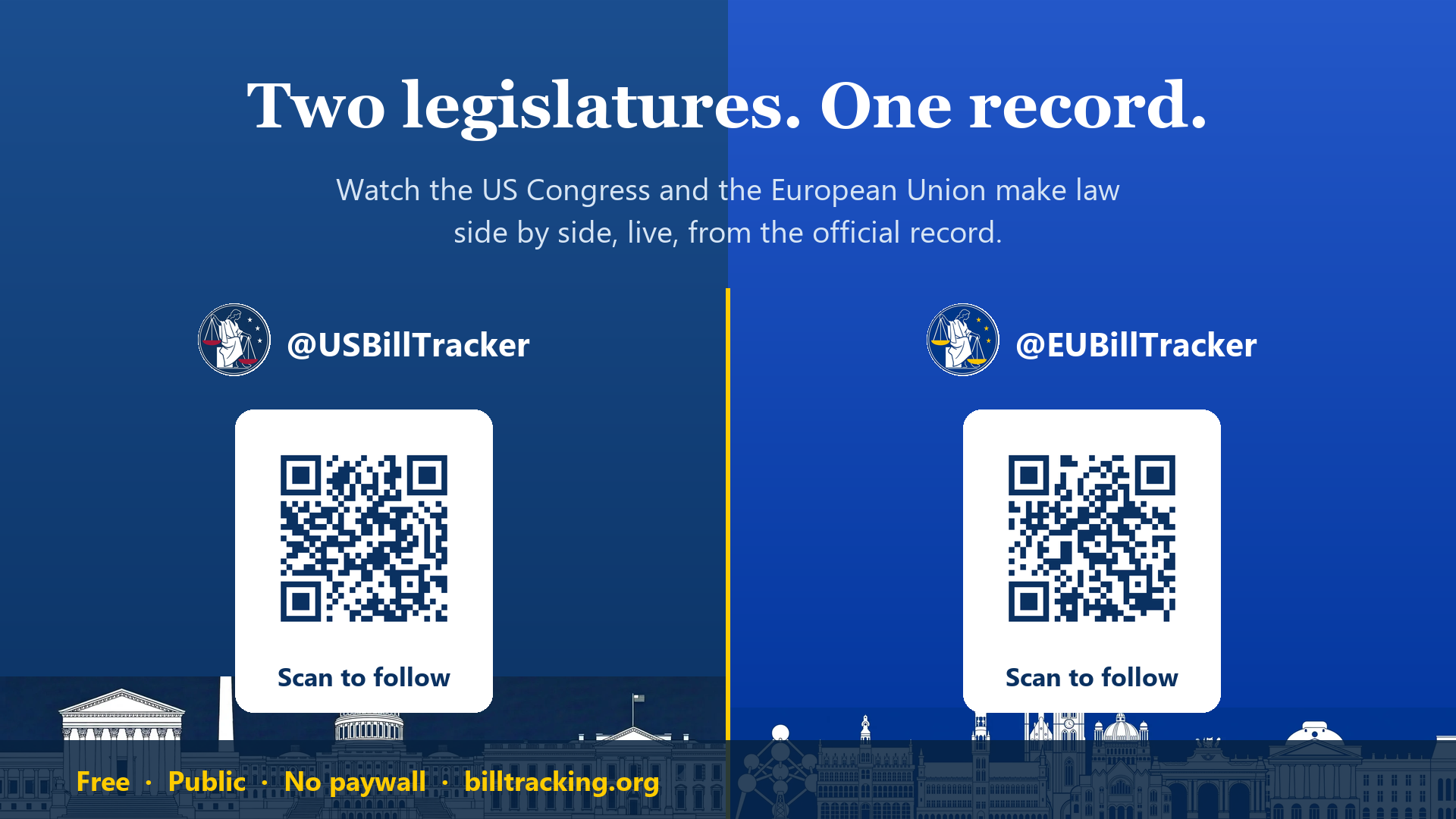
- Combined slide both feeds, side-by-side framing — for comparative courses
- Mini-deck (PPTX) 4 editable slides: the two systems side by side, how to read a US post, how to read an EU post, follow — lift any slide into your own deck
- Verification exercise (PDF) one-page assignment handout, ready to distribute
- Syllabus blurbs (txt) ready sentences for US, EU and comparative courses — also below
- Everything (zip) the full kit in one download
Copy-paste syllabus blurbs
We will follow @USBillTracker on X (x.com/USBillTracker) this semester — an automated, source-linked feed that posts every step of legislation moving through Congress, from committee to the President's desk, straight from the Congress.gov record. Free and public; background at billtracking.org.
We will follow @EUBillTracker on X (x.com/EUBillTracker) this semester — an automated, plain-English feed of every legislative procedure moving through the European Parliament and Council, from the EU's official registers. Free and public; background at billtracking.org.
We will follow @USBillTracker and @EUBillTracker on X this semester — twin automated feeds posting every step of US and EU lawmaking from the official records, in one format. Watching the two systems process legislation side by side is the course's running case study. Free and public; background at billtracking.org.



Practicalities
Using it is deliberately boring
Link a feed from the syllabus or LMS, or point students at this site. Following takes a free X account — where many of your students already are; this site itself requires nothing at all. Both accounts post around the clock; legislation doesn't keep office hours. Start with the process pages — they were written to be assignable:
Questions, ideas, requests
Teaching a course where this could fit, and want something we don't do yet? Tell us — the project is young and instructor feedback steers it: contact@billtracking.org.